


A wooden wine rack transforms any space into an elegant showcase for your collection while protecting bottles under optimal conditions. Whether you're furnishing a residential cellar, restaurant, hotel bar, or simply adding functional beauty to your kitchen, selecting the right design, material, and configuration ensures both longevity and visual appeal. This comprehensive guide explores the key considerations for choosing and integrating wooden wine storage, from timber selection and joinery to modular layouts and sustainable sourcing.
Understanding Wooden Wine Rack Construction
The structural integrity of a wooden wine rack depends on careful material selection, joint design, and load distribution. Traditional racks rely on mortise-and-tenon or dowel joints to bear the considerable weight of full bottles, while modern modular systems often employ interlocking components and metal hardware for quick assembly. Engineers at the USDA Forest Products Laboratory have extensively documented wood properties relevant to furniture design, including compression strength perpendicular to grain and long-term deflection under sustained loads.
Load-Bearing Capacity and Joinery
A single 750 ml wine bottle weighs approximately 1.2 to 1.5 kilograms when full. A typical 72-bottle wooden wine rack must therefore support at least 90 to 108 kilograms, plus a safety margin. Hardwoods such as oak, ash, and walnut offer superior compression and bending strength compared to softwoods, making them ideal for load-bearing rails and shelves. Joinery methods vary widely:
- Mortise-and-tenon: Traditional and extremely strong, ideal for freestanding racks with minimal hardware
- Dowel joints: Faster to machine, suitable for modular systems with repeating geometry
- Dado and rabbet: Common in stackable cube designs, offering good alignment and load transfer
- Bolted assemblies: Allow disassembly and reconfiguration, essential for commercial installations
Proper joint design distributes bottle weight across multiple contact points, preventing racking and ensuring stability even when loaded asymmetrically.
Material Movement and Moisture Dynamics
Wood expands and contracts with seasonal humidity changes, a phenomenon critical to long-term rack performance. The Forest Products Laboratory’s finishing guidance explains how unfinished hardwoods can move 3 to 8 percent across the grain as relative humidity swings between 30 and 80 percent. Racks installed in climate-controlled wine cellars experience minimal movement, while those in unconditioned basements or kitchens must accommodate greater dimensional change.
Quarter-sawn timber exhibits less tangential movement than flat-sawn boards, making it preferable for vertical dividers and critical structural members. A quality finish, such as hard-wax oil or polyurethane, slows but does not eliminate moisture exchange. Designers should allow clearance gaps in fixed installations and avoid constraining wide panels that need to expand.
Selecting the Right Timber Species
Choosing a timber species for a wooden wine rack involves balancing aesthetics, mechanical performance, sustainability, and cost. The American Hardwood Export Council’s species guide provides detailed profiles on hardwoods commonly used in European and North American furniture manufacturing, including Janka hardness, density, and workability ratings.
| Species | Density (kg/m³) | Janka Hardness (N) | Grain Character | Common Finishes |
|---|---|---|---|---|
| Oak | 670–760 | 5,990 | Prominent, open | Natural, oil, smoked |
| Walnut | 610–660 | 4,490 | Fine, straight | Clear, oil |
| Ash | 640–710 | 5,870 | Coarse, striking | White wash, natural |
| Maple | 630–710 | 6,450 | Tight, uniform | Natural, stained |
| Pine | 500–550 | 2,800 | Knotty, rustic | Clear, burnt, oil |
Oak remains the most popular choice for European wine racks due to its strength, attractive grain, and historical association with barrel-making. Smoked oak adds a darker, more contemporary aesthetic without relying on chemical stains. Walnut offers rich colour and excellent machining properties, though at a premium price. Pine provides a cost-effective, lighter option suited to smaller racks or rustic interiors, particularly when finished with burnt or oiled treatments.
Sustainable Sourcing and Certification
Responsible timber procurement has become a priority for discerning buyers and commercial specifiers alike. FSC certification guarantees that wood originates from well-managed forests where harvesting rates do not exceed growth, biodiversity is protected, and workers' rights are respected. When choosing a wooden wine rack, verify that the manufacturer sources certified timber and can provide chain-of-custody documentation.
European oak from responsibly managed forests offers an excellent combination of low embodied carbon (short transport distances), superior performance, and environmental stewardship. Specifying FSC-certified materials also aligns with green building standards and corporate sustainability commitments in the hospitality and retail sectors.
Design Configurations for Every Space
Wooden wine racks are available in numerous configurations to suit residential, commercial, and hospitality environments. Selecting the right layout depends on bottle capacity, floor area, ceiling height, and aesthetic integration with surrounding interiors.
Freestanding and Modular Systems
Freestanding racks offer maximum flexibility, allowing repositioning as collections grow or spaces are reconfigured. Modular designs stack vertically or extend horizontally, creating wine walls that fill entire alcoves or partition open-plan rooms. These systems typically feature:
- Individual bottle cradles angled at 5 to 15 degrees to keep corks moist
- Vertical dividers spaced at 95 to 105 mm centres to accommodate standard Bordeaux and Burgundy bottles
- Optional shelf units for magnums, champagne, or display accessories
- Adjustable feet or levelling plates to compensate for uneven floors
Modular wooden wine racks simplify installation and future expansion, making them popular in restaurants and wine bars where inventory turnover demands adaptable storage.
Wall-Mounted and Built-In Solutions
Wall-mounted racks maximise floor space in compact kitchens, dining rooms, and boutique retail environments. Securely fixed to studs or masonry, these racks cantilever bottles outward, creating a floating display that adds visual interest to plain walls. Built-in systems integrate with millwork, cabinetry, and under-stair voids, delivering bespoke storage that appears seamless with the architecture.
Both approaches require careful load calculation and fixing specification. A wall-mounted wooden wine rack holding 36 bottles exerts over 50 kilograms of shear force on its fixings, necessitating heavy-duty brackets, toggle bolts, or masonry anchors rated well above the static load.
Corner and Niche Designs
Corner wine racks exploit otherwise wasted space in L-shaped kitchens, cellar corners, and alcoves. Triangular or quadrant layouts nest bottles radially, often incorporating a lazy-Susan base for easy access to rear positions. Niche designs, meanwhile, slot into recesses between studs or beneath counters, providing discreet storage without impinging on circulation.
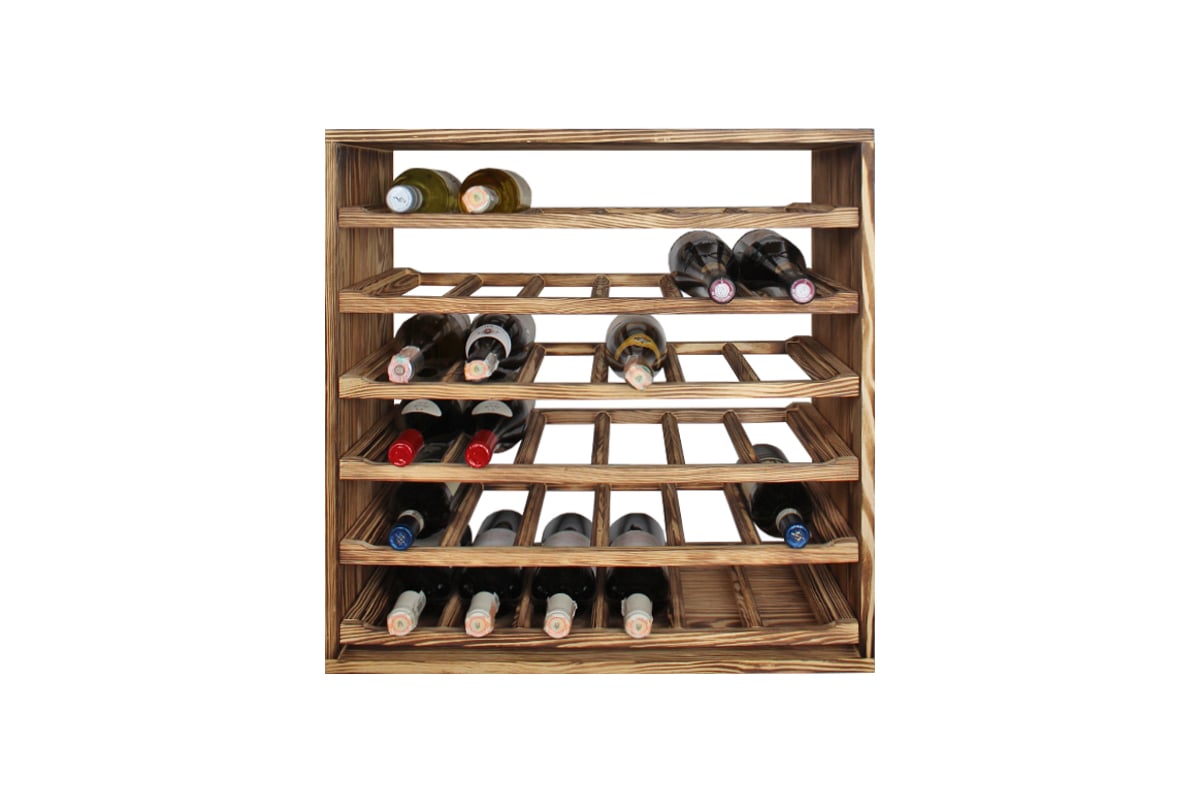
If you're seeking premium wooden wine racks crafted from solid oak, smoked oak, pine, and burnt pine, Museliving offers modular systems designed for homes, restaurants, hotels, and commercial spaces across Europe. Each piece combines Scandinavian minimalism with functional durability, manufactured to order with custom sizes and finishes.
Finishing and Protecting Wood Surfaces
Surface treatment significantly affects the appearance, durability, and maintenance requirements of a wooden wine rack. Finishes serve multiple purposes: enhancing grain and colour, sealing pores against moisture and staining, and providing a tactile surface that complements the interior aesthetic.
Natural Oils and Waxes
Hard-wax oils penetrate the timber surface, curing within the cell structure to stabilise moisture content while leaving a low-sheen, tactile finish. These treatments accentuate natural grain patterns, making them ideal for oak and walnut racks where character is prized. Benefits include:
- Easy touch-up and maintenance with additional oil application
- Low VOC emissions compared to solvent-based lacquers
- Renewable and biodegradable formulations
- Minimal film build, reducing risk of cracking or flaking
Natural oils require periodic reapplication, typically every 12 to 24 months in high-use or humid environments. They offer moderate protection against water spotting and wine spills, making them suitable for cellars and dining rooms but less ideal for outdoor or bar settings.
Lacquers, Varnishes, and Polyurethanes
Film-forming finishes create a durable barrier that resists moisture, alcohol, and abrasion. Two-pack polyurethanes and catalysed lacquers deliver commercial-grade protection for restaurant and hotel installations where frequent cleaning and heavy handling are expected. These finishes can be applied in gloss, satin, or matt sheens, each influencing the perceived colour and depth of the timber.
Application quality is paramount. Proper surface preparation, including sanding to 220 grit or finer, ensures good adhesion and a smooth final appearance. Professional spray application yields the most uniform results, though brush-applied varnishes remain popular for DIY projects. The detailed finishing chapter from the Forest Products Laboratory outlines best practices for moisture conditioning, coating selection, and curing schedules.
Smoked and Burnt Treatments
Thermally modified finishes, such as smoked oak and burnt pine, alter the timber's colour and stability through controlled heat exposure. Smoking darkens oak to rich chocolate tones without chemical stains, while flame-charring (Shou Sugi Ban) creates striking black surfaces on pine and other softwoods. Both treatments reduce hygroscopic movement and enhance rot resistance, though they require careful handling during machining to avoid chipping.
These finishes pair exceptionally well with contemporary and industrial interiors, offering dramatic contrast when combined with metal accents or light-coloured walls. A smoked oak wooden wine rack can serve as a statement piece in open-plan living areas or boutique wine shops.
Integrating Racks into Cellars and Living Spaces
Strategic placement and environmental control determine how well a wooden wine rack preserves your collection and enhances your interior. Wine storage ideally occurs at 10 to 15°C with 60 to 70 percent relative humidity, conditions that also favour dimensional stability in timber furniture.
Climate Considerations and Humidity Control
Professional wine cellars incorporate HVAC systems designed to maintain precise temperature and humidity, as detailed in ASHRAE’s refrigerated-facility guidance. Residential installations, however, often rely on passive strategies: locating racks in basements or north-facing rooms, insulating enclosures, and using vapour barriers to prevent moisture migration. Wooden wine racks installed in conditioned spaces require minimal special treatment beyond the standard finish.
In unconditioned environments, avoid placing racks near radiators, south-facing windows, or appliances that emit heat. Excessive temperature fluctuations accelerate cork degradation and can cause wine to expand and seep past closures, staining labels and diminishing value.
Lighting and Display Integration
Ambient and task lighting accentuate the beauty of timber grain and bottle labels while guiding navigation in larger collections. LED strip lighting mounted beneath shelves or behind vertical dividers delivers energy-efficient, low-heat illumination that won't compromise wine quality. Avoid direct UV exposure, which fades labels and can degrade certain wine compounds.
For retail and hospitality applications, backlit wooden wine racks create striking focal points. Frosted acrylic or glass panels diffuse light evenly, highlighting bottles as decorative objects. Dimmable controls allow mood adjustment for dining or tasting events.
DIY Construction Versus Professional Solutions
Building a wooden wine rack from scratch appeals to woodworkers seeking a custom solution tailored to specific dimensions and bottle counts. Popular Mechanics’ step-by-step DIY build and the project walkthrough from Woodworkers Journal offer detailed plans, cut lists, and joinery guidance suitable for intermediate skill levels.
Tools and Techniques for Home Builders
Constructing a basic freestanding rack requires a table saw or circular saw, drill, router (for decorative edges), and clamps. Precision is critical: bottle openings must be uniform to prevent jamming or breakage. Common pitfalls include:
- Inadequate clamping pressure during glue-up, leading to weak joints
- Misaligned holes or slots that bind during assembly
- Insufficient sanding, resulting in splinters and rough surfaces
- Neglecting grain direction, causing uneven staining or finish absorption
Home builders should also account for material waste. Plan cuts carefully to maximise yield from each board, particularly when working with premium hardwoods where cost per board-foot is high.
Advantages of Ready-Made and Custom-Commissioned Racks
Professional manufacturers offer several benefits over DIY construction: engineered joints tested for load capacity, consistent finish quality, and warranty support. Ready-made racks arrive flat-packed with pre-drilled holes and comprehensive assembly instructions, reducing installation time to hours rather than days. Custom-commissioned pieces, meanwhile, accommodate non-standard bottle sizes, architectural constraints, and bespoke aesthetic requirements.
For commercial projects where downtime, safety certification, and design cohesion are paramount, specifying professionally manufactured racks is almost always the prudent choice. Restaurants, hotels, and retail wine merchants also benefit from faster lead times and the ability to order matching units as their collections expand.
Maintenance and Long-Term Care
A well-maintained wooden wine rack can serve for decades, even in demanding commercial environments. Routine care involves dusting, occasional refinishing, and inspecting joints for looseness or damage.
Regular Cleaning and Inspection
Dust and particulate matter accumulate in bottle cradles and horizontal surfaces, especially in cellars with earth floors or poor ventilation. Wipe racks monthly with a soft, dry cloth or vacuum using a brush attachment. Avoid water-based cleaners on oiled finishes, as moisture can raise grain and dull the surface. For lacquered racks, a damp microfibre cloth followed by immediate drying is safe.
Inspect fixings, dowels, and glue joints annually. Tighten loose screws, replace damaged brackets, and re-glue separating joints before they compromise structural integrity. Address any signs of mould, mildew, or insect activity immediately; these issues typically indicate excessive humidity or inadequate ventilation.
Refinishing and Restoration
Natural oil finishes require periodic renewal. Clean the surface thoroughly, lightly sand any raised grain with 320-grit paper, and apply a fresh coat of hard-wax oil. Allow 24 hours for curing before replacing bottles. This simple process restores lustre and renews moisture protection.
Lacquered surfaces may develop scratches or clouding over time. Minor imperfections can be buffed out with polishing compound, but extensive damage necessitates professional refinishing: stripping the old coating, re-sanding, and applying new lacquer. For heirloom or antique wooden wine racks, consult a furniture restorer experienced in historic finishes and joinery.
Sizing and Capacity Planning
Accurate capacity planning prevents the common mistake of underestimating future growth. Collections expand as enthusiasts discover new regions, vintages, and varietals, making scalability a key design criterion.
Bottle Dimensions and Rack Geometry
Standard Bordeaux bottles measure approximately 75 mm in diameter and 300 mm in height, while Burgundy bottles are slightly wider at 80 to 85 mm. Champagne and sparkling wine bottles require even larger openings due to their pronounced shoulders and punt depth. When specifying or building a wooden wine rack, ensure cradle dimensions accommodate your collection profile:
- Bordeaux: 95 mm centres, 100 mm depth
- Burgundy: 105 mm centres, 110 mm depth
- Champagne: 115 mm centres, 120 mm depth
- Magnum: 150 mm centres, 150 mm depth
Mixed-format racks incorporate adjustable or varied cradle sizes, offering flexibility for diverse collections. Commercial installations often dedicate specific zones to each bottle type, simplifying inventory management and improving visual order.
Calculating Total Capacity
Capacity depends on rack height, width, and the number of tiers. A single-column rack 200 cm tall with 10 cm vertical spacing holds approximately 20 bottles. Expanding to a five-column wall yields 100 bottles. Modular systems simplify scaling: add vertical or horizontal modules as needed, maintaining visual consistency and structural integrity. For residential cellars, plan for 150 to 200 percent of your current collection to allow headroom for acquisitions.
Complementary Furniture and Interior Harmony
A wooden wine rack rarely stands in isolation. Thoughtful integration with surrounding furniture, cabinetry, and décor amplifies its visual impact and functional utility.
Pairing wine storage with dining tables crafted from matching timber and finish creates cohesion between entertaining and storage zones. Similarly, coordinating finishes with bedroom furniture or living-room shelving ties disparate spaces together through material continuity.
In open-plan interiors, a freestanding wooden wine rack can act as a subtle room divider, delineating kitchen, dining, and lounge areas without blocking sightlines or natural light. This strategy works particularly well in loft apartments, converted warehouses, and contemporary extensions where fluid spatial relationships are prized.
Scandinavian Design Principles
Scandinavian furniture design emphasises clean lines, natural materials, and functional simplicity, principles that align perfectly with timber wine storage. Avoiding ornate carvings and excessive detailing, Scandinavian-inspired racks celebrate the inherent beauty of wood grain and joinery. Tapered legs, rounded edges, and understated hardware contribute to a timeless aesthetic that complements both traditional and modern interiors.
Neutral finishes such as natural oak, white-washed ash, and lightly oiled pine integrate seamlessly with minimalist colour palettes and organic textures. For those seeking deeper tones, smoked oak or walnut offer richness without sacrificing the restrained elegance characteristic of Nordic design.
Selecting a wooden wine rack that balances aesthetics, durability, and sustainability requires attention to timber species, joinery methods, finish quality, and environmental integration. Whether you opt for a compact wall-mounted design, a modular system that grows with your collection, or a bespoke built-in installation, prioritising certified materials and expert craftsmanship ensures lasting performance. Museliving specialises in handcrafted solid wood furniture inspired by Scandinavian design, offering premium modular wine racks made from FSC-certified oak, smoked oak, pine, and burnt pine. Every piece is manufactured to order across Europe, combining timeless style, exceptional quality, and sustainable production to help you create elegant, functional living and commercial spaces.